
UK NBA Betting Tips and Data-Driven Picks 2026
 Available in US
Nine years ago, I placed my first NBA spread bet from a flat in East London. The line was Lakers minus 4.5. I had no model, no system, no clue what tempo-adjusted efficiency meant. I just liked the Lakers. That bet lost by 12, and it was the most expensive basketball lesson I’ve ever paid for. Every framework I’ve built since — the spread models, the prop valuations, the schedule-edge filters — grew out of that one poorly reasoned punt.
The landscape I stumbled into back then barely resembles what exists today. In 2025 alone, legal sportsbooks in the United States accepted $166.94 billion in wagers, generating a record $16.96 billion in operator revenue — a 22.8% jump year on year. Basketball commands 15 to 18 percent of global betting turnover, and on certain American platforms its share of handle climbs above 31%. Those numbers matter to you sitting in Manchester or Glasgow because the liquidity flowing through NBA markets determines how sharp the lines are, how quickly odds adjust, and how much value is left on the table by the time you open your app at half-seven in the evening.
170 million
US viewers watched NBA games in the 2025-26 season — a 24-year high, up 86% from the prior year
$166.94 billion
Total legal sports wagers placed in the US in 2025, with basketball claiming up to 31% of handle at major operators
15-18%
Basketball’s share of worldwide betting turnover — second only to football globally

Meanwhile, the NBA itself has exploded in cultural reach. The 2025-26 regular season drew over 1.3 billion hours of viewing across linear and streaming platforms — a 93% rise from the season before. More eyeballs mean more casual bettors piling in, which means softer lines and wider edges for anyone doing the homework. But only if you know where to look, what to measure, and how to think about the sport through a UK-market lens — decimal odds, UKGC-licensed operators, and a tax environment that just shifted dramatically under your feet.
This guide is built for UK punters who want more than a daily tip sheet. I’ll walk you through the markets, the metrics, the schedule traps, and the bankroll discipline that separate long-term winners from the crowd refreshing their bet slip at midnight hoping Jayson Tatum covers. Whether you’re placing your first NBA wager or refining a model you’ve run for years, every section here is grounded in data I actually use.
- Nine Years of UK NBA Spread Modelling Data Analyzed
- The UK NBA Betting Landscape in 2026
- NBA Betting Markets Explained for UK Punters
- Advanced Stats That Move NBA Lines
- Finding Value: Expected Value and Closing Line Value
- Schedule Edges: Back-to-Backs, Rest Days, and Travel
- Bankroll Management for NBA Bettors
- Live NBA Betting: Opportunities in Real Time
- Integrity, Regulation, and Responsible Betting
- Frequently Asked Questions
Nine Years of UK NBA Spread Modelling Data Analyzed
- The NBA betting market processed over $166 billion in US handle in 2025 alone — that liquidity creates sharp lines, but also exploitable gaps for bettors who move early on injury news and schedule edges.
- UK punters face a transformed tax landscape: Remote Gaming Duty doubled to 40% in April 2026, squeezing operator margins and making odds comparison across bookmakers more important than ever.
- Expected value and closing line value, not win rate, are the true measures of betting skill — a 56% probability estimate on a line priced at 52.4% is a positive-EV bet regardless of tonight’s result.
- Pace, Net Rating, and efficiency metrics are free, public, and directly applicable to spread and totals projections that most recreational bettors never build.
- Bankroll discipline — flat staking at 1-2% per bet, honest tracking, pre-bet checklists — is the infrastructure that lets an edge compound instead of collapse during a losing streak.
The UK NBA Betting Landscape in 2026
I run a standing group chat with four other NBA bettors in the UK, and every April we compare notes on how the season went. The consistent theme over the past three years: the market is getting bigger, the regulation is getting tighter, and the margins are getting thinner. All three of those trends define where we stand right now.
The UK sports betting market generates approximately £2.48 billion in gross gambling yield annually — that’s around $3.3 billion flowing through UKGC-licensed operators on sport alone. Around 10% of the UK adult population places online sports bets, with roughly 290 million individual wagers logged every month across all sports. NBA sits inside that ecosystem as a niche product compared to Premier League football, but it’s a niche that keeps growing as streaming access improves and more UK punters discover the sport’s betting depth.
UKGC Regulation at a Glance — Every bookmaker offering NBA markets to UK customers must hold a licence from the UK Gambling Commission. This means ring-fenced customer funds, mandatory responsible gambling tools (deposit limits, reality checks, self-exclusion via GamStop), and strict advertising standards. If an operator is not listed on the UKGC public register, walk away — your money has zero protection.
The demographic skew is sharp: 15% of men in the UK bet on sport versus just 4% of women, and 76% of 18-to-24-year-old gamblers use mobile devices as their primary channel. NBA, with its late-night tip-offs and highlight-reel culture, indexes strongly with that younger mobile-first audience. Games typically start between 23:00 and 03:30 GMT, which means the betting window sits in a quieter part of the UK market cycle — fewer competing events, less public attention, and occasionally softer lines than you’d find during a Saturday afternoon Premier League slate.
But the biggest structural shift of 2026 is fiscal. Andrew Rhodes, CEO of the UK Gambling Commission, has described the current environment as “an ever-evolving landscape in terms of gambling innovation — the increasingly globalised nature of the industry, the evolution of gambling products and services, and the potential use cases for Artificial Intelligence.” That evolution now includes a tax shock: Remote Gaming Duty jumped from 21% to 40% on 1 April 2026, with remote betting duty set to rise from 15% to 25% from April 2027. The operators absorb some of that cost through reduced promotions and tighter odds margins. What that means practically is that the decimal price you see on an NBA spread today carries a larger embedded tax load than it did twelve months ago. Value is still findable — but the bar has risen.
UK bettors place roughly 290 million online wagers on real-world events every single month — and that figure has been climbing year on year since 2022, driven largely by mobile in-play markets.
None of this should discourage you. The UK remains one of the most robustly regulated betting markets on the planet, and UKGC licensing gives you protections that punters in many other jurisdictions simply don’t have. What it does mean is that a casual, gut-feel approach to NBA betting is less forgiving than ever. The operators are pricing NBA lines with increasingly sophisticated models, the tax burden is higher, and the promotional landscape is leaner. Your edge has to come from analysis, not from a welcome offer.
NBA Betting Markets Explained for UK Punters
Walk into any UKGC-licensed sportsbook app during an NBA game week and the sheer number of markets can feel like standing in a supermarket aisle staring at forty types of cereal. Spreads, handicaps, totals, moneylines, props, quarters, bet builders — the menu is enormous. The good news: you don’t need all of them. You need to understand five core market types deeply enough to spot where the pricing is soft and where the bookmaker has the edge baked in tight.
Match Winner (Moneyline)
The simplest NBA bet: pick who wins. Decimal odds reflect implied probability — a price of 1.50 implies a 66.7% chance. Favourites carry thin margins; underdogs are where moneyline value lives.
Point Spread (Handicap)
The team must win by more than the spread (or lose by fewer points than the handicap). UK bookmakers display this as a handicap line — e.g., Team A -5.5 at 1.91. Functionally identical to US spreads, different label.
Totals (Over/Under)
A combined-score line for both teams. You bet whether the final total lands over or under. Pace and defensive efficiency drive these numbers more than any single player.
Player Props
Individual performance lines — points, rebounds, assists, threes, and combination markets. Props are the fastest-growing NBA betting segment and the one where bookmaker models are weakest.
Bet Builders (Same-Game Parlays)
Combine multiple selections from the same game into one wager. Correlation between legs is the key concept — and the key trap. The bookmaker’s margin is highest here, so construction matters enormously.
| Format | Example | Payout on £10 Stake | Implied Probability |
|---|---|---|---|
| Decimal (UK standard) | 1.91 | £19.10 | 52.4% |
| Fractional | 10/11 | £19.09 | 52.4% |
| American | -110 | £19.09 | 52.4% |
Spread (Handicap) — A points margin applied to one team to level the perceived contest. If a team is listed at -6.5, they must win by 7 or more for the bet to pay. UK bookmakers often label this “handicap” rather than “spread,” but the mechanics are identical.
Moneyline (Match Winner) — A straight-up bet on which team wins the game. No points margin involved. Decimal odds of 2.00 represent an even-money proposition (50% implied probability before margin).
Totals (Over/Under) — A market on the combined final score of both teams. The bookmaker sets a line — say 221.5 — and you bet whether the actual total finishes above or below it.
Props (Player Performance Bets) — Markets tied to individual statistics rather than team outcomes. Common NBA props include points scored, rebounds, assists, three-pointers made, and combination markets like points + rebounds + assists.

The critical UK-specific detail: most British bookmakers default to decimal odds, which makes implied-probability calculations trivially simple. Divide 1 by the decimal price and you have the implied probability including margin. For a price of 1.91, that’s 1 / 1.91 = 0.5236, or 52.4%. Compare that to your own probability estimate for the outcome. If your number is higher, you’ve potentially found value. If it’s lower, move on. That single calculation — done honestly and consistently — is the foundation of everything else in this guide.
Point Spreads and Handicaps: Reading the Line
The first NBA spread I ever dissected properly was a Celtics-Knicks regular-season game where Boston was favoured by 7.5 points. I remember thinking: that’s a big number for two decent teams. But the context told a different story — the Knicks were on the second night of a back-to-back, missing their starting centre, and Boston had been dominant at home all month. The line wasn’t inflated; it was efficient. Learning to read why a spread sits where it sits, rather than just whether it “looks” big or small, is the skill that changed my results.
At UK bookmakers, a point spread appears as a handicap. Team A -6.5 at 1.91 means Team A starts the game with a notional deficit of 6.5 points for betting purposes — they must win by 7 or more for your bet to land. The half-point eliminates the possibility of a push (a tie against the spread), which is why you’ll see lines at .5 increments far more often than whole numbers.
Reading a UK Handicap Line
Step 1: The bookmaker posts Team A -5.5 at 1.91 and Team B +5.5 at 1.91.
Step 2: You back Team A -5.5. This means Team A must win the game by 6 or more points.
Step 3: Final score: Team A 112, Team B 105. The margin is 7 points. Subtract the handicap: 7 – 5.5 = 1.5. Team A “covers” by 1.5 points. Your bet wins.
Step 4: On a £20 stake at 1.91, your return is £38.20 (£18.20 profit).
The spread is the great equaliser of NBA betting. It turns a blowout mismatch into a coin-flip proposition, which means the edge comes not from picking winners — anyone can do that 55% of the time — but from identifying games where the market has mispriced the margin. That mispricing is what spread analysis and ATS strategy are designed to exploit. I’ll cover the mechanics there in depth, including how ATS records, home-away splits, and line movement feed into a systematic approach.
Totals and Pace: When to Go Over or Under
Totals betting is where I started to make consistent money in the NBA, and the reason is straightforward: most recreational bettors gravitate toward overs. They want action, they want points, and they want to cheer for baskets. That public bias creates a structural lean toward over-priced overs and under-priced unders — not always, not dramatically, but persistently enough to matter across a full season.
The line itself — say 224.5 — represents the bookmaker’s estimate of the combined final score. Your job is to build a better estimate. The two inputs that matter most are pace (how many possessions each team generates per 48 minutes) and efficiency (how many points each team scores and allows per 100 possessions). When a fast-paced team averaging 102 possessions per game meets a slow-paced team averaging 96, the game’s expected pace is somewhere around 99 possessions — and the total should reflect that pace, not the raw averages of each team’s recent scores.
Rough Totals Projection
Step 1: Estimate game pace — the average of both teams’ season pace figures. Suppose Team A averages 100.2 possessions, Team B averages 97.8. Expected game pace: roughly 99 possessions per team.
Step 2: Estimate each team’s scoring. Team A offensive rating (ORTG): 114.5 points per 100 possessions. Team B defensive rating (DRTG): 112.0. Team A’s expected output: (114.5 + 112.0) / 2 * 99 / 100 = approximately 112.0 points.
Step 3: Repeat for Team B’s scoring against Team A’s defence.
Step 4: Sum both estimates. If your number lands at 219 and the posted line is 224.5, the under looks attractive.
This is a simplified model — a real projection would weight recent form, account for missing players, and adjust for rest and travel. But the principle holds: totals are a math problem dressed up as a guess. The more precisely you estimate pace and efficiency, the more often you’ll land on the right side. And when your projection disagrees with the posted line by three or more points, that’s where the strongest totals plays live.
Advanced Stats That Move NBA Lines
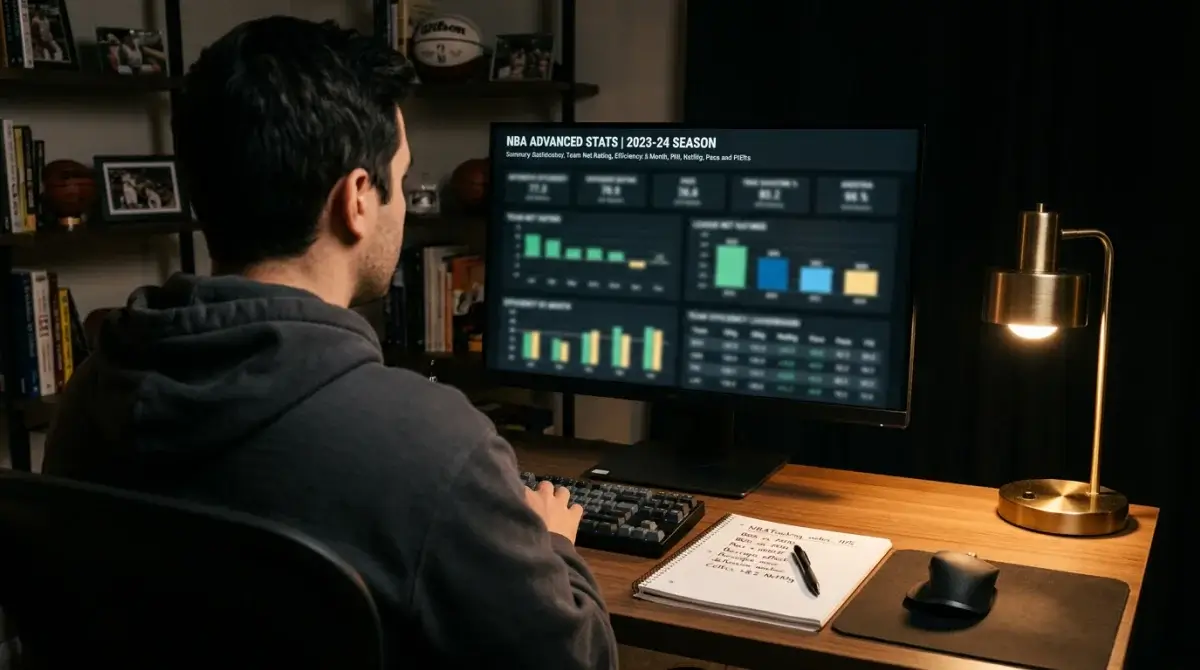
A mate of mine — sharp bettor, been doing this longer than me — once said that the day he stopped looking at box scores and started looking at efficiency ratings was the day he stopped losing money. I’ve found the same thing. Points per game tells you almost nothing useful for betting. Points per 100 possessions tells you nearly everything.
The NBA’s statistical infrastructure is the richest in professional sport. Every game produces tracking data on player movement, shot quality, defensive contest rates, and dozens of derived metrics that teams and bookmakers use to set their own projections. You don’t need to build a machine-learning pipeline to benefit from this — you need to understand four core metrics and know where to find them for free.
Net Rating — The difference between a team’s offensive rating (points scored per 100 possessions) and defensive rating (points allowed per 100 possessions). A team with a Net Rating of +6.0 outscores opponents by 6 points per 100 possessions — a strong indicator of true quality, far more reliable than win-loss record.
Effective Field Goal Percentage (eFG%) — Adjusts standard field goal percentage to account for the extra value of three-pointers. A team shooting 45% from the field but making a high volume of threes will have a significantly higher eFG% than a team shooting 47% on mostly two-pointers.
True Shooting Percentage (TS%) — The most comprehensive single measure of scoring efficiency, incorporating two-point field goals, three-point field goals, and free throws into one number.
Pace — The number of possessions a team uses per 48 minutes. Pace dictates the volume of scoring opportunities and is the single most important input for totals betting.
The 2025-26 season produced over 1.3 billion hours of NBA viewing globally, and that audience expansion has pushed the analytical conversation deeper into mainstream coverage. Net Rating, eFG%, and pace are now routinely cited on pre-game broadcasts, which means bookmakers are baking them into their models more aggressively than ever. Your advantage doesn’t come from knowing these numbers exist — it comes from applying them to specific betting contexts: a team with elite defensive efficiency facing one with high pace, a squad whose eFG% craters on the road, a back-to-back situation where fatigue drags offensive rating down by a measurable margin. The sections that follow put these metrics to work in concrete betting scenarios.
Understanding the stats is step one. The next question: how do you use them to identify bets where the price is wrong?
Finding Value: Expected Value and Closing Line Value
There’s a question I ask every new NBA bettor I mentor: “Do you know why your last bet was good?” Not whether it won — whether it was good. The distinction matters more than anything else in this guide, and it hinges on a concept called expected value.
Expected value — EV — is the average profit or loss you’d expect from a bet if you could place it thousands of times under identical conditions. A positive-EV bet doesn’t guarantee a win tonight. It guarantees profit over time if your probability estimates are honest. Every sharp bettor I know, every profitable model I’ve studied, operates on this single principle: find positive EV, bet it, repeat.
Calculating Expected Value on an NBA Spread Bet
Step 1: The bookmaker offers Team A -4.5 at decimal odds of 1.91.
Step 2: Convert the odds to implied probability: 1 / 1.91 = 52.4%.
Step 3: Your model estimates Team A covers -4.5 with 56% probability.
Step 4: Calculate EV: (0.56 x 0.91) – (0.44 x 1.00) = 0.5096 – 0.44 = +0.0696. That’s +£0.07 per £1 staked.
Step 5: Positive EV. The bet has value regardless of tonight’s outcome.
The worked example above uses a £1 stake for clarity, but the logic scales to any amount. The critical input is Step 3 — your probability estimate. If that number is wrong, the entire calculation collapses. This is why serious NBA bettors spend their energy on building better probability estimates rather than hunting for “locks” or “best bets.” There are no locks. There are only prices that are right and prices that are wrong.
Win rate tells you what happened. Closing line value tells you whether you deserved it. Enter the price you took and the price the market closed at, and the calculator strips the margin out of both, converts the gap into expected return, and projects it across a season.
How it works. Both prices are de-vigged proportionally, so the two sides of each market sum to one hundred per cent and the bookmaker’s margin is stripped out. The closing no-vig probability is treated as the best available estimate of the true chance, because the close is where all the sharp money, injury news and market corrections have landed. Expected return is that probability multiplied by the price you actually took, minus one. Deeper treatment in the guides to betting strategy and spread picks.
Estimates only, and CLV is a measure of process rather than a promise of profit. With Remote Gaming Duty at 40 per cent since April 2026, overrounds have widened and de-vigging matters more than it did a year ago. 18+ — please gamble responsibly. Free, confidential support at BeGambleAware.
Closing Line Value (CLV) — The closing line is the final set of odds posted just before tip-off, after all the sharp money, injury news, and market corrections have been priced in. If you consistently bet at better odds than the closing line — say you took Team A -4.5 at 1.91, and the line closed at Team A -5.5 at 1.91 — you are demonstrating CLV. Over a large sample, positive CLV is the single strongest predictor of long-term profitability. It proves your assessment of the market was ahead of the market itself.
Back in 2014, NBA Commissioner Adam Silver wrote publicly that sports betting should be brought into the open where it can be properly monitored and regulated. That openness has created a massive, efficient market — but efficient doesn't mean perfect. The NBA betting market is efficient at the close, not at the open. Lines move from open to close as information flows in. Your window for capturing value is the gap between your analysis and the market's current price. The earlier you act on a correct read, the more CLV you collect. The later you act, the more the market has already adjusted to where you are.
I track CLV on every single bet I place. Over a season, my average CLV hovers around 1.5 to 2 cents on the dollar — modest, but compounding over hundreds of bets, that margin is the difference between a winning year and a losing one. If you want a practical walkthrough of how to build an EV framework and measure your own CLV, the player props guide applies the same valuation logic to individual performance markets, where the pricing inefficiencies are often larger than on team-level lines.
Schedule Edges: Back-to-Backs, Rest Days, and Travel
Last February, I hit a run of seven consecutive winning spread bets over a ten-day stretch. None of them involved complicated modelling. Every single one was a schedule spot — a rested home team against a squad playing the second night of a back-to-back after a cross-country flight. The NBA's 82-game regular season is an endurance test, and the wear is not distributed evenly. That unevenness is one of the most reliable edges available to anyone willing to check a calendar.
The core idea is simple: tired teams underperform their baseline. A team playing on zero days' rest, particularly on the road, sees measurable declines in offensive efficiency, defensive intensity, and effort on the glass. The magnitude varies by roster depth and coaching philosophy — some teams absorb back-to-backs better than others — but the aggregate trend is persistent and well-documented. When a 170-million-viewer season like 2025-26 creates this much demand for content and scheduling density, the league cannot eliminate the fatigue factor. It can only manage it.
Do
- Check the schedule for both teams before evaluating any line — rest advantage is often already priced in, but not always fully.
- Weight recent back-to-back performance for the specific team. Some squads with deep benches handle the second night well; others collapse.
- Factor in travel distance. A West Coast team flying to the East Coast for a back-to-back is carrying a heavier load than a team playing two home games in a row.
- Monitor injury reports closely on back-to-back nights — star players are frequently rested, and their absence may not be priced into early lines.
Don't
- Blindly bet against every team on the second night of a back-to-back. The market knows about schedule spots, and lines adjust accordingly.
- Ignore the rest advantage of the opposing team. The biggest edge comes when one team is rested and the other is fatigued — the mismatch matters more than either factor alone.
- Assume back-to-back effects are equal across all months. Early-season back-to-backs are absorbed more easily than late-season ones when cumulative fatigue is higher.
- Neglect altitude. Denver at elevation after a long flight is a documented drag on visiting teams, and it compounds when fatigue is already a factor.
The practical application doesn't require a spreadsheet — though I use one. Before I look at any line, I check three things: days of rest for each team, distance travelled since their last game, and whether any key players are flagged as questionable on the injury report. If all three factors align in one direction — say the home team is rested, the road team flew coast-to-coast last night, and the road team's primary scorer is listed as doubtful — I know the schedule context is heavy enough to warrant a closer look at the spread and total. The detailed data on rest-day performance and back-to-back ATS records lives in the broader strategy section, where I break down how to integrate schedule factors into a systematic approach.
Bankroll Management for NBA Bettors
The best model in the world won't save you if you're staking 10% of your bankroll on every bet. I learned this the hard way during my second full NBA season — a brutal January cold streak wiped out two months of profit because my unit sizing was reckless. Bankroll management isn't the exciting part of betting. It's the part that determines whether you're still betting in March.
At its core, bankroll management means treating your betting capital as a fixed resource and sizing every wager as a controlled fraction of that resource. The standard approach is the unit system: define one unit as 1-2% of your total bankroll, and stake between one and three units per bet depending on your confidence level. On a £1,000 bankroll, one unit is £10 to £20. That feels small — deliberately so. The goal is to survive variance, and NBA variance is brutal. Even a bettor with a genuine 55% win rate on spread bets will experience losing streaks of 10 or more during a full season.
Pre-Bet Bankroll Check
- Is this bet sized at 1-3 units maximum?
- Am I increasing my stake because of a losing streak (chasing) or a winning streak (overconfidence)?
- After this bet, will my remaining bankroll still cover at least 50 units?
- Have I logged this bet in my tracking sheet before placing it?
Flat staking versus proportional staking versus Kelly Criterion — each model has trade-offs that depend on your edge size, risk tolerance, and ability to estimate probabilities accurately. The detailed walkthrough of all three approaches, including risk-of-ruin calculations, is the focus of the same-game parlay guide, which also covers how to size multi-leg bets where the variance is even higher than single-game wagers.
Live NBA Betting: Opportunities in Real Time
The first time I placed a live NBA bet, I didn't realise how fast the odds moved. I was watching a Bucks game, saw Giannis pick up his third foul early in the second quarter, and by the time I navigated to the in-play market the spread had already shifted by 2.5 points. That speed is the defining feature of NBA live betting — and the reason it now dominates the market.
In-play betting accounted for 62.35% of the online US sports betting market in 2025, and that share is projected to grow at a compound annual rate of nearly 14% through 2031. Within that category, micro-betting — wagering on the outcome of the next play, the next basket, the next free throw — has exploded, growing 214% year on year in 2024 and now representing 38% of all in-play bets on major platforms. The NBA has leaned into this trend directly: the league offers a streaming product that lets you watch just the fourth quarter of any game for $1.99, a product designed explicitly for the in-game betting audience.
Micro-betting — wagering on next-basket, next-turnover, and other play-by-play outcomes — grew by 214% in a single year and now accounts for 38% of all in-play wagers on major US platforms.

For UK punters, the live NBA window opens late in the evening and runs into the early hours. That timing has a practical advantage: you're betting when you're watching, which means you can see things the algorithm hasn't priced yet. A key player limping on a non-contact play, a team's ball movement breaking down in the half-court, a shift in defensive scheme after a timeout — these are real-time signals that live odds models, however sophisticated, process with a slight lag. The edge in live betting comes from that lag.
Quarter and half-time markets offer a middle ground between full-game bets and rapid-fire micro-bets. First-quarter spreads and first-half totals isolate segments of the game where specific team tendencies — fast starts, dominant third quarters, defensive intensity after halftime adjustments — can be more predictable than full-game outcomes. These markets carry less variance than micro-betting and give you more time to evaluate your position.
The risk of live betting is real and worth naming plainly: speed breeds impulsive decisions. The dopamine loop of bet-result-bet-result over 48 minutes of basketball can drain a bankroll faster than any pre-match losing streak. Every live bet should pass the same value test as a pre-match bet — does my probability estimate exceed the implied probability of the price? If you can't articulate why you're betting, close the app. A detailed breakdown of live betting mechanics, platform comparison, and discipline frameworks for UK punters is available in the dedicated live betting guide.
Integrity, Regulation, and Responsible Betting
In 2025, NBA Commissioner Adam Silver stood at a press conference and said he felt "a pit in my stomach" over integrity concerns. That phrase stuck with me — not because it was dramatic, but because it was honest. The man running a league that generates billions in betting handle was publicly admitting the stakes had risen to a level that worried him. "If this game isn't viewed as being honest and the competition being on the level and at the highest integrity, over time we will lose our fan base," Silver said at an NBA Cup event. "I have no doubt about that."
He's right to worry. The NBA currently monitors betting activity across roughly 40 jurisdictions in the US and on international markets, tracking anomalous patterns that might suggest insider information or manipulation. The league partners with 17 authorised gaming operators and has invested heavily in real-time surveillance systems. On the regulatory side, the UK Gambling Commission reported blocking more than 117,000 URLs of illegal gambling sites by the end of 2025 — up from 27,000 at the start of that year. The machinery of enforcement is substantial and growing.

But the cases keep coming. A federal prosecutor described one recent scheme as "an insider sports betting conspiracy that exploited confidential information about National Basketball Association athletes and teams." Players themselves have spoken publicly about the pressure. Tyrese Haliburton of the Indiana Pacers put it bluntly: "To half the world, I'm just helping them make money on DraftKings or whatever. I'm a prop." Coaches have reported receiving threats tied to betting outcomes — messages about their families, their home addresses. The human cost of the betting boom is not abstract.
What does this mean for you as a UK bettor? Two things. First, bet with UKGC-licensed operators exclusively. The regulatory protections — fund segregation, dispute resolution, self-exclusion tools — exist because integrity monitoring alone can't prevent every bad actor. Licensed operators participate in the league's authorised framework; unlicensed ones don't. Second, pay attention to integrity news. A voided bet, a suspended market, a player banned for gambling violations — these events can affect your open positions. The global illegal gambling market is estimated at $1.7 trillion; the regulated ecosystem you're operating in is a fraction of that, and it's regulated precisely because the alternative is chaos.
Responsible Gambling — Betting on the NBA should be entertainment backed by analysis, not a financial strategy or an emotional outlet. Use the tools your operator provides: deposit limits, session time reminders, reality checks, and self-exclusion via GamStop if you need it. If betting stops feeling like a choice, it's a problem. The National Gambling Helpline is available 24/7.
Remote Gaming Duty at 40%: What It Means for Your Odds
The fiscal ground shifted on 1 April 2026. Remote Gaming Duty — the tax UK-licensed online gambling operators pay on their gross gambling yield — jumped from 21% to 40%. A further increase to remote betting duty, from 15% to 25%, is scheduled for April 2027. The government projects that gambling tax receipts will rise by 24.8% to £5 billion in the 2026-27 fiscal year.
The impact on operators has been immediate and public. Per Widerström, CEO of Evoke — the parent company of William Hill — stated that the tax increase "will involve a significant reduction in investment into the UK and, very regrettably, the likely need for thousands of jobs to be cut." Entain projected an EBITDA hit of £100 million in 2026 and £150 million in 2027. Flutter estimated losses of $235 million and $339 million in those same years.
The 40% Remote Gaming Duty means operators must recover more margin from every bet you place. Expect tighter odds, fewer promotional offers, and higher overrounds on NBA markets compared to twelve months ago. Value still exists — but you need sharper analysis to find it, because the tax has raised the floor on what operators need to charge.
For you as a punter, the mechanism is indirect but real. Operators don't add "tax surcharge" to your bet slip. Instead, they adjust their pricing models — slightly wider overrounds, slightly less generous promotions, slightly tighter cash-out terms. The decimal odds you see on an NBA spread have always included the bookmaker's margin; that margin is now absorbing a near-doubling of the tax rate. Comparing odds across multiple UKGC-licensed operators has always been good practice. In the current fiscal environment, it's essential.
Frequently Asked Questions
How do NBA point spreads work for UK bettors using decimal odds?
A point spread — displayed as a handicap at UK bookmakers — assigns a points margin to one team. If Team A is listed at -5.5 with decimal odds of 1.91, Team A must win by 6 or more points for the bet to pay. You simply multiply your stake by the decimal odds to calculate the return: a £10 bet at 1.91 returns £19.10 if it wins. The implied probability is 1 divided by the decimal odds — so 1.91 implies a 52.4% chance. Any time your own probability estimate exceeds that number, the spread bet has value.
What are the most profitable NBA betting strategies for beginners?
Start with one market — spread or totals — and learn it deeply before branching out. Focus on expected value rather than win rate: a strategy that wins 53% of spread bets at standard odds is profitable over a full season, while one that wins 60% on parlays may not be. Track every bet in a spreadsheet, record your reasoning, and review weekly. Flat staking at 1-2% of your bankroll per bet protects you from the variance that wipes out most beginners during their first losing streak.
How does the NBA schedule — back-to-backs, rest days, road trips — affect betting lines?
Teams on the second night of a back-to-back, especially on the road after significant travel, show measurable declines in offensive efficiency and defensive effort. Bookmakers adjust lines for these situations, but the adjustment is not always complete — particularly when injury report news drops late and the line has limited time to move. The largest edges tend to appear when one team is fully rested at home and the opponent is fatigued from a back-to-back with cross-country travel.
How do advanced stats like Net Rating and pace translate into betting edges?
Net Rating — the difference between points scored and points allowed per 100 possessions — is the single best team-level measure of true quality. It strips out the noise of blowout wins, close losses, and schedule variance. For totals betting, pace (possessions per 48 minutes) combined with offensive and defensive ratings lets you build a projected game total that you can compare to the bookmaker's posted line. When your projection diverges meaningfully from the market — by three or more points on a total, for example — that's a quantifiable edge.
How do I read and convert NBA odds between decimal, fractional, and American formats?
Decimal odds are the UK standard and the simplest: multiply your stake by the decimal price for total return. To convert to implied probability, divide 1 by the decimal odds. Fractional odds (e.g., 10/11) represent profit relative to stake — £10 at 10/11 returns £19.09 total. American odds use plus/minus notation: -110 means you stake £110 to win £100; +150 means £100 staked returns £150 profit. For practical purposes, stick with decimals — they make EV calculations effortless.
What is a same-game parlay and how does it work for NBA matches?
A same-game parlay — called a bet builder at most UK bookmakers — combines multiple selections from one NBA game into a single wager. You might pair a team spread with a player points prop and a game total. All legs must win for the bet to pay. The key concept is correlation: some legs naturally move together (a team winning big correlates with their star scorer having a high-scoring game), and understanding which legs are positively correlated helps you build constructions where the combined price offers better value than the bookmaker intends.
How do injuries and load management shift NBA betting lines?
A star player's absence can move a spread by 3 to 5 points or more, depending on the player's impact. The NBA mandates injury reports that classify players as probable, questionable, doubtful, or out. Lines adjust as this information becomes public — but the adjustment isn't instantaneous. If you monitor injury reports when they drop (typically by 17:00 ET for evening games) and act before the market fully reprices, you can capture value on the spread and on related props. Load management — where healthy stars sit out scheduled rest games — is especially exploitable on back-to-back nights when the decision is announced late.
Created by the ”bet Tips nba” editorial team.